Principle of airless vacuum saturated steam
A 3-Dimensional Technology
- Time
- Temperature
- Pressure (positive or negative)
The combined control of these three parameters optimizes microbiological effectiveness while preserving product quality.
Why is saturated steam so effective?
At 100°C, liquid water contains approximately 417 kJ of energy, while hot air contains approximately 421 kJ.
Once converted into saturated steam, its energy content reaches 2257 kJ.
Saturated steam contains an enthalpy up to five times higher than that of liquid water or hot air at the same temperature.
When the steam condenses on the surface of the product, it instantly releases this energy, ensuring rapid and homogeneous heat transfer.
How Saturated Steam Under Air Vacuum Works
1. Air Vacuum
The air is first removed from the treatment chamber.
This step is essential because air acts as a thermal insulator. By removing it, saturated steam can penetrate the product more easily and uniformly, ensuring more effective heat transfer and homogeneous treatment.
2. Steam Injection
Saturated steam is injected once the air has been removed from the treatment chamber. The absence of air promotes homogeneous steam distribution and allows it to penetrate efficiently to the core of the ingredients. As a result, the entire batch is treated uniformly.
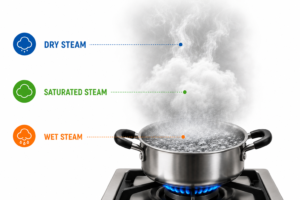
Saturated steam is considered the “perfect” steam because it maintains an optimal balance: it is neither too dry nor too wet.
3. Air Vacuum
After treatment, an air vacuum phase removes residual moisture and promotes product cooling. This helps preserve the quality and stability of the ingredients.
Microbiological Action
Saturated steam acts directly on:
- Pathogenic and non-pathogenic bacteria
- Yeasts
- Molds
- Insect infestations
- Hydrocyanic acid
while preserving the organoleptic and physicochemical properties of the products.
A Significant Reduction in Microbial Load